
Field notes · Foundations 101
Auger cast piles vs. drilled shafts
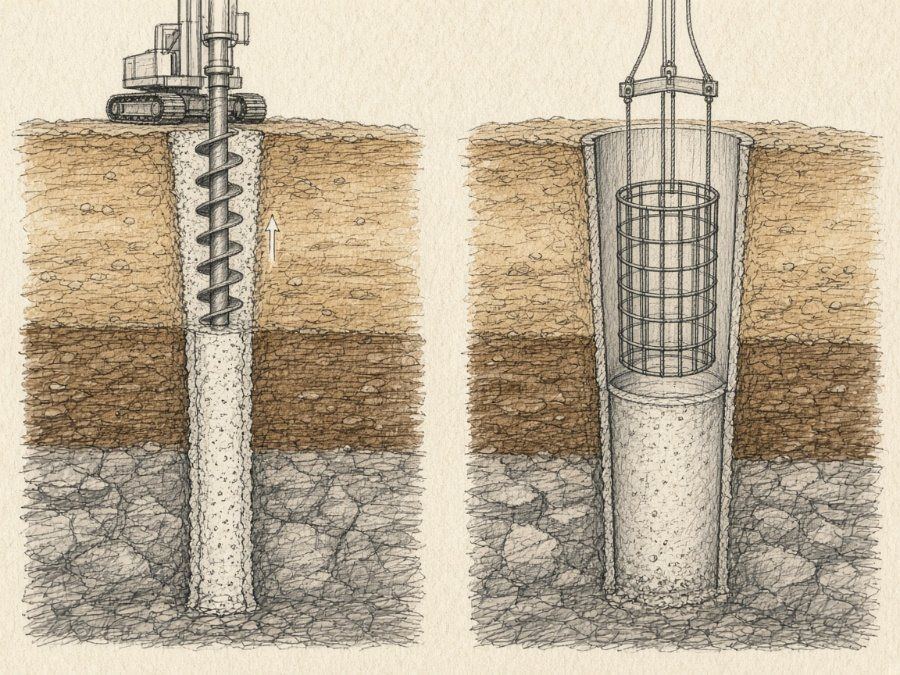
Both are deep foundations cast in place in a drilled hole. The difference is the order of work: an auger cast pile is filled with grout as the auger comes out and the steel goes in last, while a drilled shaft is bored open, the steel cage is set, and then the concrete is placed from the bottom up.
What is an auger cast pile?
An auger cast pile is a pile formed by drilling with a continuous hollow-stem auger and filling the hole with grout as the auger is withdrawn. FHWA groups it with continuous flight auger (CFA) piles, and the names are often used interchangeably.
The sequence is fixed. The auger is turned into the ground to the design depth. Grout is then pumped under pressure down the hollow stem and out of the tip while the auger is pulled back up, so the hole fills from the bottom as the auger leaves it. While drilling, the soil-filled flights support the hole; on the way out, the grout does. Last, a reinforcing cage or a single bar is pushed down into the wet grout.
Because the grout goes in out of sight, specifications typically call for recording the grout volume, pressure and auger withdrawal for each pile.
What is a drilled shaft?
A drilled shaft is a reinforced concrete column cast in a hole that is excavated first and held open until the concrete goes in. It is also called a caisson or a bored pile.
The hole is bored with an auger or bucket. In ground that caves, or below the water table, it is held open with steel casing or a drilling slurry. The bottom is cleaned, the steel cage is lowered in, and the concrete is placed from the bottom up, through a tremie pipe or pump line when there is water or slurry in the hole, so the concrete pushes the fluid up and out instead of mixing with it.
Why does the order of steel and concrete matter?
The order follows from how each hole is supported. An auger cast pile is never an open hole, so there is nowhere to hang a cage until the grout is in; the steel has to go into wet grout, and it must go in before the grout begins to stiffen. A drilled shaft is an open, supported hole, so the cage is set first and the concrete flows around it.
When is each one used?
It depends on the loads, the soil and rock, the groundwater, the room on site and the schedule. Auger cast piles are often chosen because they install quickly with less noise and vibration than driven piles. Drilled shafts are usually larger in diameter and are often used where a single foundation must carry a heavy column load or large lateral loads, or needs to be socketed into rock.
Who decides which foundation a building gets?
The geotechnical engineer recommends foundation types from the site investigation, and the structural engineer of record designs the foundation shown on the plans. A drilling contractor builds what the plans call for.
Frequently asked questions
Is an auger cast pile the same as a CFA pile?
Largely, yes. FHWA covers augered cast-in-place piles under continuous flight auger (CFA) piles, and in US practice the terms are often used interchangeably.
When does the steel go into an auger cast pile?
Last. The auger drills to depth, grout is pumped through its hollow stem as it is withdrawn, and the reinforcing cage or bar is then pushed down into the wet grout.
Do drilled shafts always need casing?
No. In stable ground above the water table a shaft can often be drilled without support. Casing or drilling slurry is used when the hole could cave or fill with water.
Can the contractor swap one foundation type for the other?
Not on their own. The foundation type is part of the engineered design, so any change goes through the geotechnical engineer and the structural engineer of record.
Sources
General information, not engineering advice. Your engineer of record decides the foundation design.